
Hyperhidrosis
Medically reviewed. Last Edited on 2026-02-20
Hyperhidrosis means that the body sweats more than is actually necessary. The sweat glands operate in ‘continuous mode,’ even when it is not hot and there is no physical exertion. The armpits, hands, or feet are particularly often affected, sometimes also the face or other body areas.
The cause is not a ‘nervousness problem’ or lack of hygiene, but rather a malfunction of the nerves that regulate sweating. These nerves send too many signals to the sweat glands, even though the body does not require cooling. This predisposition often has a genetic background, meaning it is hereditary.
Hyperhidrosis is a physical condition that affects many people and can be effectively treated today. No one should feel ashamed of it.
Overview
What is hyperhidrosis?
Hyperhidrosis means “excessive sweating” (literally translated from Greek: hyper = too much, hidros = water, thus too much sweat). The sweat glands are excessively activated and produce much more than necessary without a physical reason such as heat or exercise. This can happen spontaneously or sometimes even at night.
Sweating is inherently vital, as it cools the body and protects against overheating. In hyperhidrosis, however, this mechanism runs out of control. The autonomic nervous system, which normally controls sweating automatically, sends signals to the sweat glands that are too strong or too frequent.
What are the types of hyperhidrosis?
There are two main forms of hyperhidrosis:
- Primary Hyperhidrosis: Occurs without an identifiable underlying condition. It often begins in childhood or puberty, usually affects specific body areas, and typically stops during sleep. The exact cause is not yet fully understood, but genetic factors likely play a role.
- Secondary Hyperhidrosis: Is triggered by another illness or medication. Unlike the primary form, it often affects the entire body and can also occur at night.
How common is hyperhidrosis?
Hyperhidrosis is actually far more common than most people assume. Approximately 1 to 2 percent, with some estimates suggesting up to 5 percent, of the population is affected, which corresponds to over one million individuals in Germany alone. Many still do not seek medical help because they are unaware that hyperhidrosis is a recognized and highly treatable condition.
Symptoms
What are the symptoms of hyperhidrosis?
The main symptom of hyperhidrosis is sweating that exceeds normal levels. It can be so severe that sweat visibly penetrates through clothing or drips from the hands. Typical of the primary form is that sweating occurs at rest or with mild emotional tension, such as when shaking hands, typing, or speaking.
Typical signs include:
- Your clothing is soaked with sweat within a short time.
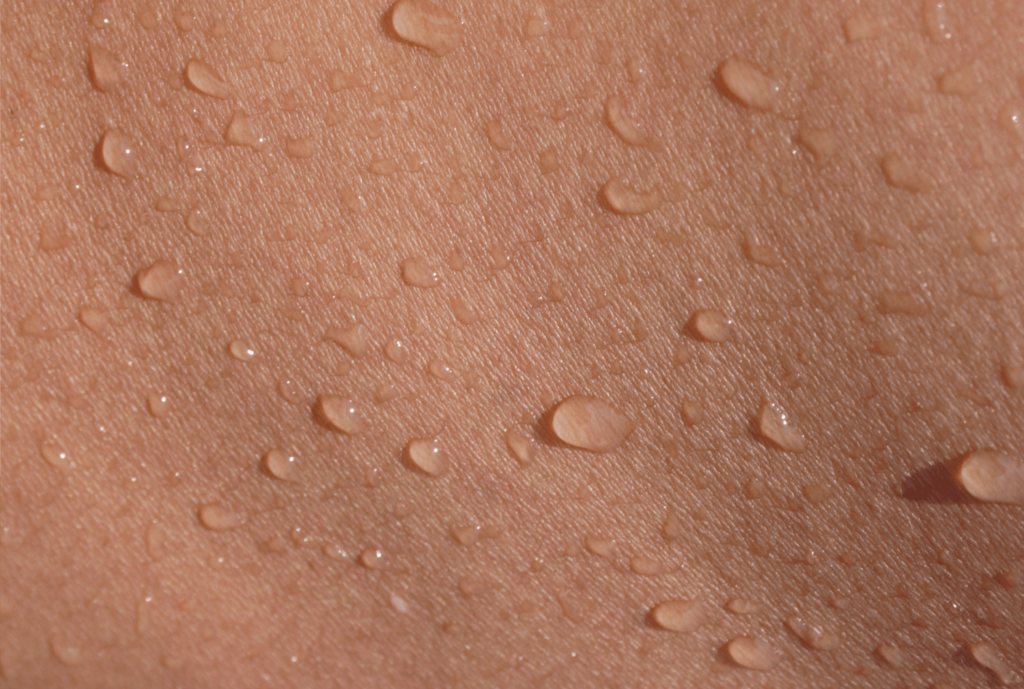
- Beads of sweat form without physical exertion.
- Your hands are so wet that objects slip from your grasp.
- You need to change your clothing several times a day.
- Sweating often occurs very suddenly, known as sweating attacks.
Those affected often also suffer from accompanying symptoms. The skin can soften due to constant moisture, which promotes fungal infections or inflammation. An unpleasant odor can also develop. This places a significant burden on many people in their social lives.
Where does hyperhidrosis occur?
With primary hyperhidrosis, sweating usually occurs only in specific areas of the body. These are referred to as focal areas, meaning clearly defined zones. The most common are:
- Armpits (axillary hyperhidrosis)
- Hands (palmar hyperhidrosis)
- Feet (plantar hyperhidrosis)
- Face and scalp (craniofacial hyperhidrosis)
- Groin and genital area (inguinogenital hyperhidrosis)
- Trunk (truncal hyperhidrosis)
Often, several of these areas are affected simultaneously. Secondary hyperhidrosis, on the other hand, frequently occurs throughout the entire body.
Causes
What are the causes of hyperhidrosis?
In primary hyperhidrosis, the exact cause is not yet fully understood, but there is a genetic predisposition. What is known: The autonomic nervous system controls the sweat glands, and in hyperhidrosis, this nerve control is overactive and sends too many signals without an external stimulus alone explaining it. Stressful situations, heat, or excitement can trigger and intensify sweating, but they are not the actual cause.
Secondary hyperhidrosis is different. Here, another condition is behind the excessive sweating. Possible triggers include:
- Hyperthyroidism (overactive thyroid)
- Diabetes mellitus
- Menopause
- Infectious diseases or chronic inflammation
- Neurological disorders (e.g., Parkinson’s disease)
- Obesity
Medications that can trigger sweating
Some medications can cause excessive sweating as a side effect. This is more common than many think and is often not recognized as such. These medications include:
- Certain antidepressants (especially SSRIs and SNRIs)
- Fever-reducing medications such as acetylsalicylic acid or ibuprofen
- Certain blood pressure medications
- Morphine and other opioid pain medications
If you are unsure whether a medication is triggering your sweating, you can schedule an appointment with one of our specialists at any time.”
Is hyperhidrosis hereditary?
There is clear evidence that primary hyperhidrosis runs in families. Studies show that over two-thirds of those affected have at least one family member with the same symptoms. In cooperation between the DHHZ and the Research Institute for Psychobiology at the University of Trier, genetic loci have been identified. Hyperhidrosis is hereditary.
Diagnosis and tests
How does a doctor diagnose hyperhidrosis?
The diagnosis of hyperhidrosis is primarily clinical, meaning it is based on a discussion with the patient and a physical examination. Your doctor will ask how long the sweating has been occurring, where exactly, whether it happens at night, and if any triggers are known. Additionally, it will be checked whether an underlying condition could be the cause.
Standardized questionnaires, such as the Hyperhidrosis Disease Severity Scale (HDSS), help to assess the severity and find the right treatment.
If the symptoms are causing you significant distress, an initial evaluation with your primary care physician may be advisable. For a specialised diagnosis and treatment, you can also book an appointment with us directly.
What tests are available to diagnose hyperhidrosis?
In addition to the discussion, there are several diagnostic tests that can help with the diagnosis:
- Iodine-starch test (Minor’s test): An iodine solution and starch powder are applied to the skin. Areas with excessive sweat turn black, making the affected zone visible.
- Gravimetry: The amount of sweat is measured directly by collecting it on filter paper, which is then weighed. This provides an objective measurement of how much sweat is actually produced.
- Sudometry: This examination visualizes the stimulus-response regulation of sweating. The dynamics of sweating differ in hyperhidrosis from “normal sweating” and are measurable. Sensors are attached to the skin, sweating is then provoked, and the sweating response to the stimulus is measured dynamically.
- Apparatus-based and blood tests: If secondary hyperhidrosis is suspected, further investigations may be necessary. For example, thyroid values, blood sugar, hormone levels, and other parameters are checked. Alternatively, imaging procedures such as CT or MRI may be required for further clarification.
Not all tests are always necessary. Which examination makes sense depends on your individual situation. You can also take our free online quick check in advance to better assess whether a medical evaluation is recommended. We offer a brief complimentary video call here, and after 12 minutes you will have clarity on how to proceed.
Treatment
How is hyperhidrosis treated?
There are many effective treatment options for hyperhidrosis. They are usually applied in stages, ranging from simple home measures to medical interventions. The appropriate treatment depends on the severity of the symptoms and the affected body areas.
Hyperhidrosis Treatment at Home
As a first step, special antiperspirants containing the active ingredient aluminum chloride are recommended. This temporarily blocks the sweat gland ducts, thereby reducing sweat production. These products are available without a prescription and are applied to dry skin in the evening. They can be effective for mild hyperhidrosis.
- Wear breathable clothing made of natural fibers so that sweat evaporates more quickly
- Functional clothing, made of materials such as polyester, transports sweat away from the skin more quickly to the next layer of clothing, ensuring a drier skin feel.
- Regularly changing socks and insoles for foot hyperhidrosis)
Hyperhidrosis Medication
For many sufferers, antiperspirants are only the first step. If they are insufficient, pharmacological options are available. These medications inhibit the nerve signals to the sweat glands, thereby reducing sweat production. They are available in two forms:
- As tablets: These act on the entire body and can regulate overall sweating as needed. They are very well tolerated and have reasonably minor side effects, such as dry mouth.
- Topical cream: Still quite new and not widely known, there is a cream from Germany whose development the DHHZ has strongly supported. Developed specifically for axillary hyperhidrosis, the medication Axhidrox® is applied directly to the affected area, passes through the skin to the gland nerves, and dampens the sweating signal. What makes it special: direct effect and fewer side effects, as only a small amount of the active ingredient is distributed throughout the body. Find out more about Axhidrox® here.
Medication-based treatment at the DHHZ can also be supported as an online treatment. Find out more about medications for hyperhidrosis here.
Further hyperhidrosis therapies
Beyond a certain level of severity, specialized therapies are used that specifically target the sweat glands or block the nerve impulses responsible for sweating.
- Tap-water iontophoresis: Hands or feet are immersed in trays of tap water through which a weak direct current flows. The procedure has been proven to reduce sweat production and has hardly any side effects. At the beginning, daily applications are necessary, which is why we prescribe such systems for home use. Once the effect has set in, maintenance sessions are sufficient. Devices are also available for home use. More information: tap-water iontophoresis
- Botulinum Toxin Injections: Botulinum toxin, often colloquially referred to as Botox®, is injected directly into the affected skin areas. It blocks nerve signals to the sweat glands and is particularly effective for underarm, hand, and foot sweating, but can also be used in all other body regions. The effect typically lasts 4 to 9 months and must be repeated thereafter. Details: botulinum toxin for hyperhidrosis
- Thermotherapy (miraDry®): The miraDry microwave therapy cauterizes the sweat glands without causing external injury. Since sweat glands do not grow back, the effect is permanent. MiraDry was developed for the treatment of underarm sweating and is also successfully used at the DHHZ—the only center worldwide to do so—on the torso and for sweating on the buttocks and in the genital area. Further information: miraDry
Hyperhidrosis Surgery
For severe hyperhidrosis that does not respond to other therapies, surgical intervention may be considered.
The most successful method for therapy-resistant palmar hyperhidrosis is Endoscopic Thoracic Sympathectomy, abbreviated as ETS or ETSC, as performed at our DHHZ, since we conduct the sympathetic blockade using clips. Titanium clips are applied to the sweat nerve, stopping the nerve impulses that trigger sweating in the hands, armpits, or head.
Sweaty feet can also be treated surgically just as effectively and permanently with a sympathetic blockade. This operation is called ELSC, Endoscopic Lumbar Sympathetic Clip Blockade, and provides sustainably dry feet. Odors disappear as well.
A sympathetic blockade is permanently effective, but it involves surgery with risks and side effects. The most important side effect is so-called “compensatory” sweating, which always occurs after ETSC and much less severely after ELSC. We have specific information on this: compensatory sweating.
For this reason, surgery is only considered when all other therapies have not provided sufficient success. And very importantly: We can assess compensatory sweating through special examinations before surgery.
More information: Surgery / ETS
Are there any side effects of the treatment?
Which side effects may occur depends heavily on the treatment chosen and varies greatly from person to person. That is why a therapy tailored to you personally is so important.
Antiperspirants are generally well tolerated, but may occasionally cause irritation in sensitive skin. Anticholinergic tablets work systemically, inhibiting the gland nerves and are therefore more frequently associated with dry mouth. Botulinum toxin injections are very well tolerated, although temporary pressure pain at the injection site or—when used on the hands—slight muscle weakness are possible.
Surgery, like any procedure, carries risks and side effects, and therefore the level of distress and the chance of success must be carefully weighed. However, this is offset by the enormous and lasting effect. Therefore, individual consultation is always important here.
Thorough examinations, a clear diagnosis, comprehensive information about all available treatment options, and an experienced team to support you will bring you the best treatment outcome.
How long does the treatment take?
How long a treatment takes cannot be stated generally, as it depends heavily on the chosen method. Antiperspirants and iontophoresis are not one-time measures; they only work as long as they are applied regularly. Botulinum toxin lasts several months and must then be repeated. Thermotherapy (miraDry) and surgical procedures are generally permanent.
Hyperhidrosis is a chronic condition with a genetic background. However, this does not mean you have to suffer permanently. And regardless of whether a treatment goal can be achieved quickly or takes some time—we will accompany you until success is reached.
Frequently asked questions
What can I expect in the long term?
Hyperhidrosis can be effectively treated in nearly all cases. With the therapy that is right for you, sweating will noticeably reduce and approach a normal level. This will make your daily life significantly easier and your quality of life will improve considerably.
With primary hyperhidrosis, it can rarely happen that symptoms gradually subside over time, for example in later adulthood. However, this cannot be predicted with certainty. The vast majority of those affected have the condition for life and suffer for years. People often choose different careers, and often even different life partners. You simply cannot just wait hyperhidrosis out.
When should I see a doctor?
You should seek medical advice if:
- sweating restricts your daily routine, work, or social life
- you suddenly experience heavy sweating that you have not experienced before
- sweating occurs at night and wakes you up
- fever, unintentional weight loss, or other symptoms occur
- you have tried initial self-help measures that have not been effective
Newly occurring night sweats or sudden generalized sweating over the entire body are warning signs that should be medically investigated – they may indicate underlying conditions requiring treatment.
Which doctor should I see for hyperhidrosis?
General practitioners are often the first point of contact. They can assess whether another cause is behind the sweating and whether further examinations are advisable. If necessary, you will also receive a referral.
Dermatologists are also often good advisors for hyperhidrosis. They can categorize the symptoms and discuss with you which treatments are generally suitable. However, not all dermatologists specialize in this area.
If you desire a specialized assessment, a clear diagnosis, and guided therapy planning from the start, you are welcome to contact the German Hyperhidrosis Center directly. We will review your situation thoroughly and discuss the appropriate next steps together. You can schedule an initial appointment here.
Will health insurance cover the treatment?
Which costs are covered by health insurance funds depends not only on the specific fund, but also very much on the type of treatment. Some treatments, such as the use of antiperspirants, are considered minor and are very inexpensive. Iontophoresis therapy is almost always covered by health insurance funds. For medicinal treatments, a medical certificate can help. Other therapies, such as botulinum toxin or miraDry, are billed privately.
As health insurance funds may decide differently on a case-by-case basis, it is always worth clarifying the cost issue specifically before starting treatment. Please seek advice at the practice and, if necessary, ask your health insurance fund directly. This way, you will know early on what to expect.
Experts you can trust
Medically reviewed by PD Dr. Schick. Last updated on 2026-02-20
Created by the DHHZ editorial team. Medically reviewed by specialists. Based on evidence-based knowledge and current clinical standards.
Sources
- Schick CH. Pathophysiology and Therapy of Hyperhidrosis. Forum Sanitas – The Informative Medical Magazine · Issue 3, 2025, pp. 36-38. Accessed on March 8, 2026.
- Association of the Scientific Medical Societies in Germany (AWMF). Definition and Therapy of Primary Hyperhidrosis (S1 Guideline, Registration Number 013-059) (https://register.awmf.org/assets/guidelines/013-059l_S1_Definition-Therapie-primaeren-Hyperhidrose_2023-07.pdf). Retrieved on February 15, 2026.
- Hornberger J. et al. Recognition, diagnosis, and treatment of primary focal hyperhidrosis (https://www.jaad.org/article/S0190-9622%2804%2900515-8/fulltext). Retrieved on February 15, 2026.
- McConaghy J. R., Fosselman D. Hyperhidrosis: Management Options (https://www.aafp.org/pubs/afp/issues/2018/0601/p729.html). Retrieved on February 15, 2026.
- National Institute for Health and Care Excellence (NICE). Hyperhidrosis – Management (CKS) (https://cks.nice.org.uk/topics/hyperhidrosis/management/). Retrieved on February 15, 2026.
- International Hyperhidrosis Society. Diagnosis Guidelines (https://www.sweathelp.org/about-hyperhidrosis/diagnosis-guidelines.html). Retrieved on February 15, 2026.
- Validity and reliability of the hyperhidrosis disease severity scale (HDSS) (https://www.jaad.org/article/S0190-9622%2803%2903534-5/fulltext). Retrieved on February 15, 2026.
- MSD Manuals, Professional Edition. Hyperhidrosis (https://www.msdmanuals.com/professional/dermatologic-disorders/sweating-disorders/hyperhidrosis). Retrieved on February 15, 2026.
- New England Journal of Medicine. Botulinum Toxin A for Axillary Hyperhidrosis (Excessive Sweating) (https://www.nejm.org/doi/pdf/10.1056/NEJM200102153440704). Retrieved on February 15, 2026.
- Glaser D. A. et al. Topical glycopyrronium tosylate for the treatment of primary axillary hyperhidrosis (https://www.jaad.org/article/S0190-9622%2818%2932224-2/fulltext). Retrieved on February 15, 2026.
- El-Samahy M. et al. Safety and efficacy of oxybutynin in patients with hyperhidrosis: systematic review and meta-analysis of randomized controlled trials (https://link.springer.com/content/pdf/10.1007/s00403-023-02587-5.pdf). Retrieved on February 15, 2026.
- Three-Year Results Following Microwave Therapy in Patients with Axillary Hyperhidrosis (https://link.springer.com/article/10.1007/s00266-025-05469-5). Retrieved on February 15, 2026.
- Lin Z., Lin M. Which patients are more likely to experience compensatory hyperhidrosis after endoscopic thoracic sympathectomy: a meta-analysis and systematic review (https://peerj.com/articles/19097/). Retrieved on February 15, 2026.
Start treatment now
Start your treatment now on-site or from the comfort of your own home. Together, we will find the best solution and support you until the optimum treatment is achieved.